I Spent $347/Month on Brain Supplements. This $1.46/Day Mushroom Gummy Replaced My Entire Stack.
A self-described supplement nerd breaks down exactly how she went from 9 daily supplements to 3 — and why every metric she tracks either held or improved.


The product that replaced 6 of my 9 daily supplements — and cut my monthly spend by 74%.
I'm going to tell you something embarrassing.
Every morning for the past three years, I've stood at my kitchen counter and taken nine separate supplements. Lined up in a row like little soldiers. Capsules, softgels, tablets, tinctures. A ritual that takes 4 minutes and costs me $347 every single month.
My husband calls it "the pharmacy." My kids call it "mom's medicine counter." My friend Megan once took a photo of my supplement shelf and texted it to our group chat with the caption: "Rachel's supplement collection has its own zip code."
I track my HRV with a Whoop. I've read every Huberman episode transcript on cognitive performance. I own three copies of Outlive by Peter Attia because I keep lending them out and never getting them back. I'm not a casual supplement taker — I'm the person my friends text at 11pm when they want to know if magnesium threonate is actually worth it. (It is. But that's another article.)
So when Megan sent me an Instagram ad for a mushroom gummy and said "this covers like six of your supplements," I did what any self-respecting biohacker would do.
I rolled my eyes and ignored it for two weeks.
My $347/Month Supplement Stack
Here's exactly what I was taking every morning, what it cost, and why. I'm sharing this because I know there are other women reading this who have a similar lineup — maybe not nine bottles, but five or six — and you've never actually added up the monthly total.
| Supplement | Monthly Cost | What It Does |
|---|---|---|
| Lion's Mane capsules | $45 | NGF stimulation, neural repair |
| Ashwagandha (KSM-66) | $28 | Cortisol regulation |
| Omega-3 fish oil | $35 | Brain inflammation, DHA |
| Magnesium L-threonate | $22 | Sleep, neural connectivity |
| Vitamin D3 + K2 | $15 | Baseline health |
| B-complex | $18 | Methylation, energy |
| CoQ10 (ubiquinol) | $42 | Mitochondrial energy / ATP |
| Alpha-GPC | $32 | Acetylcholine, focus |
| L-theanine | $25 | Calm focus, smooth out caffeine |
| TOTAL: $347/month | $11.57/day | |
Eleven dollars and fifty-seven cents. Every day. For three years. That's over $12,400 spent on brain supplements since I turned 43.
And honestly? I felt pretty good. Not great. Pretty good. Which is the most frustrating answer possible when you're spending that kind of money.
"Have You Tried the Mushroom Gummies?"
Megan wouldn't stop. She brought it up at book club. She texted me a screenshot of the ingredient label. She sent me a TikTok of some woman saying she'd dropped four supplements after starting them.
My first reaction was the one any experienced supplement buyer has: most mushroom products are garbage.
I don't say that to be dramatic. I say it because the majority of "mushroom supplements" on the market use mycelium grown on grain — which means you're mostly eating rice starch with trace amounts of fungal compounds. It's the supplement industry's worst-kept secret. The label says "mushroom," but the active compound concentration is negligible.
I know the difference between mycelium and fruit body. I know that beta-glucan content is what matters, not milligrams of powder. I know that most brands hide behind proprietary blends because their actual doses are embarrassing.
So I told Megan I'd look into it. And I expected to debunk it in about fifteen minutes.
See What Stopped Me from Closing the Tab →60-day money-back guarantee · Free shipping on bundles
What I Found When I Actually Read the Label
Three things stopped me from closing the browser tab.
1. 100% fruit body extract. Not mycelium on grain. Not a blend. Every single one of the 10 mushrooms in this formula uses the actual fruiting body — which is where the beta-glucans, hericenones, and active compounds actually live. This is the first thing I check, and most brands fail here.
2. Clinical dosing with a published COA. They publish their third-party Certificate of Analysis. You can actually see the polysaccharide content, heavy metal testing, and microbial analysis. In three years of buying supplements, I've requested COAs from maybe a dozen brands. About half never responded.
3. Ten mushrooms covering three mechanisms. Not ten mushrooms for the sake of a bigger number on the label — ten mushrooms that map to the three root causes of cognitive decline I'd been trying to address with nine separate products.
That third point is what got me. Because I already knew the three mechanisms. I'd been spending $347 a month specifically targeting them. The question was whether one product could actually cover them.
The 3 Root Causes I'd Been Spending $347/Month to Address
If you follow any of the longevity or neuroscience content out there, you've heard bits and pieces of this. But here's the framework that finally made me understand why one product could replace six.
Cognitive decline after 40 isn't one problem. It's three problems happening simultaneously:
Root Cause #1: NGF Decline (Neural Repair)
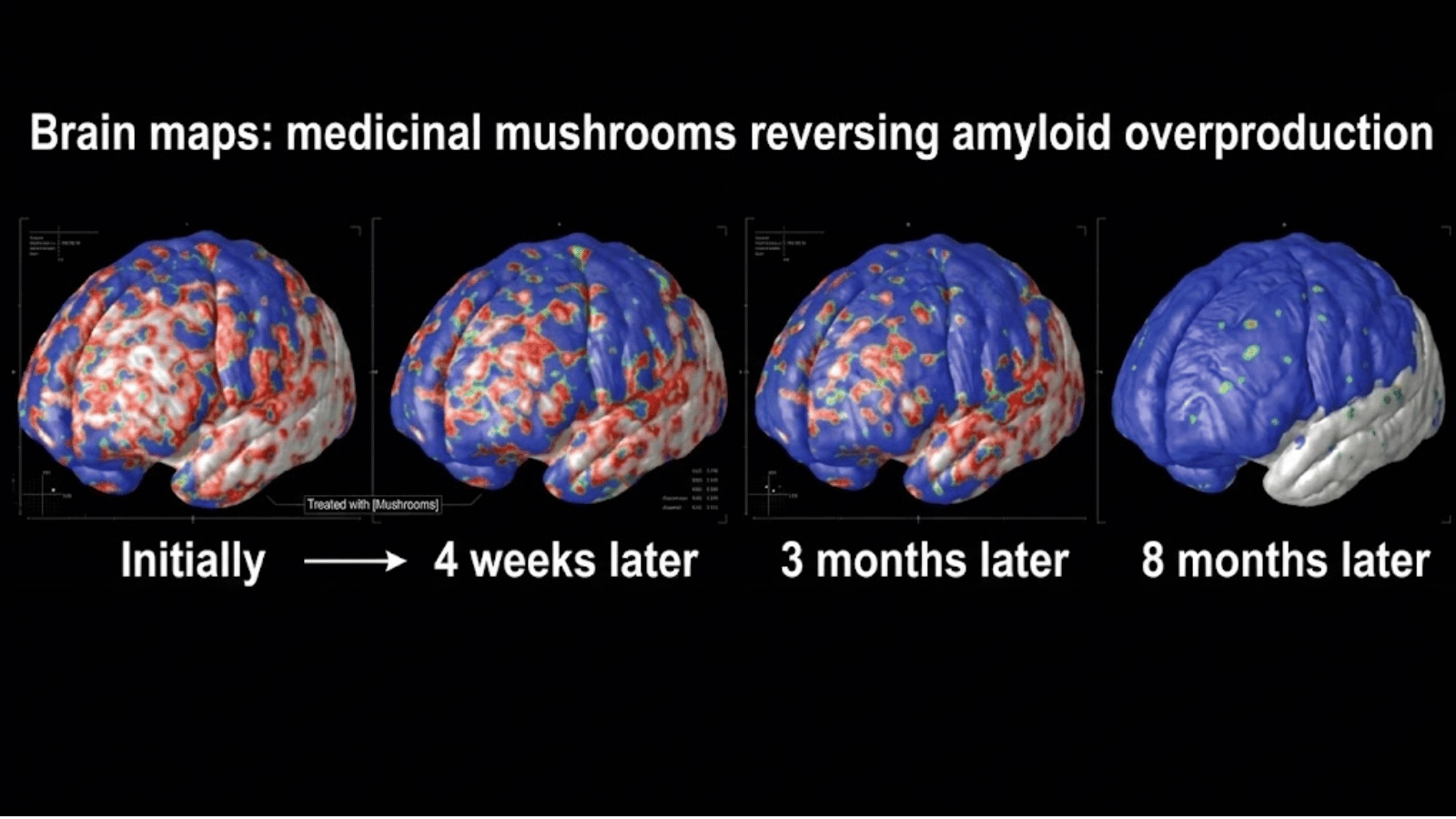
Nerve Growth Factor (NGF) is the protein your neurons depend on for maintenance and repair.
After 35, your brain produces less Nerve Growth Factor (NGF) — the protein responsible for maintaining, repairing, and growing new neural connections. This is why you start forgetting names. Why you can't hold a thought as long as you used to. Why reading feels harder than it did ten years ago.
I was spending $45/month on standalone Lion's Mane capsules and $32/month on Alpha-GPC to address this. $77 a month targeting one mechanism.
Root Cause #2: Cortisol / Dopamine Disruption
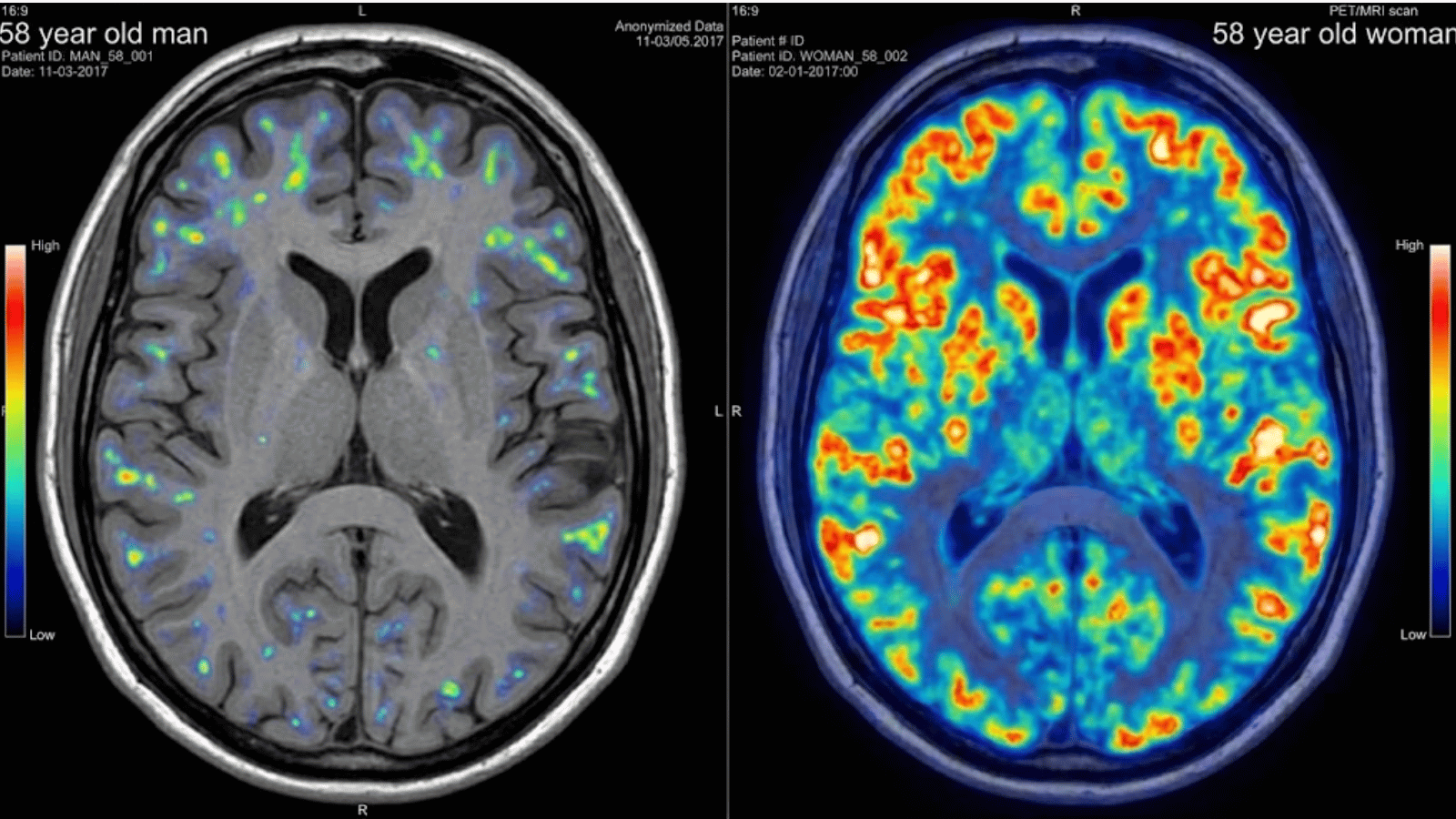
Chronic cortisol elevation damages the hippocampus and suppresses dopamine over time.
Chronic stress floods your system with cortisol. Cortisol depletes dopamine. Dopamine is the neurotransmitter that says "yes, I can focus on this task right now." When it's depleted, you get that feeling of staring at your laptop knowing you should be working but physically unable to engage.
I was spending $28/month on ashwagandha and $25/month on L-theanine to manage this. $53 a month on stress and focus regulation.
Root Cause #3: Mitochondrial Energy (ATP)
Healthy mitochondria produce the ATP your neurons need for focus, recall, and processing speed.
Your brain is 2% of your body weight but uses 20% of your total energy. That energy comes from mitochondria — and mitochondrial efficiency drops with age. This is the 2pm crash. The afternoon where you can't form a sentence. The reason you need a second coffee just to make it to dinner.
I was spending $42/month on CoQ10 and $18/month on a B-complex for cellular energy support. $60 a month on fuel production.
Add it up. I was spending $190/month targeting three mechanisms — with six separate supplements — and the remaining three bottles ($72/month) were for foundational needs that mushrooms don't address.
See the 10-Mushroom Blend That Covers All 3 →4.8 stars from 13,000+ verified reviews
The 4-Layer Protocol: How Each Mushroom Replaces a Specific Supplement
This is the part that sold me. Not the marketing. Not the testimonials. The actual ingredient mapping. I sat down with the Sky Nutrition label, pulled up my supplement spreadsheet, and mapped each mushroom against what I was already taking.

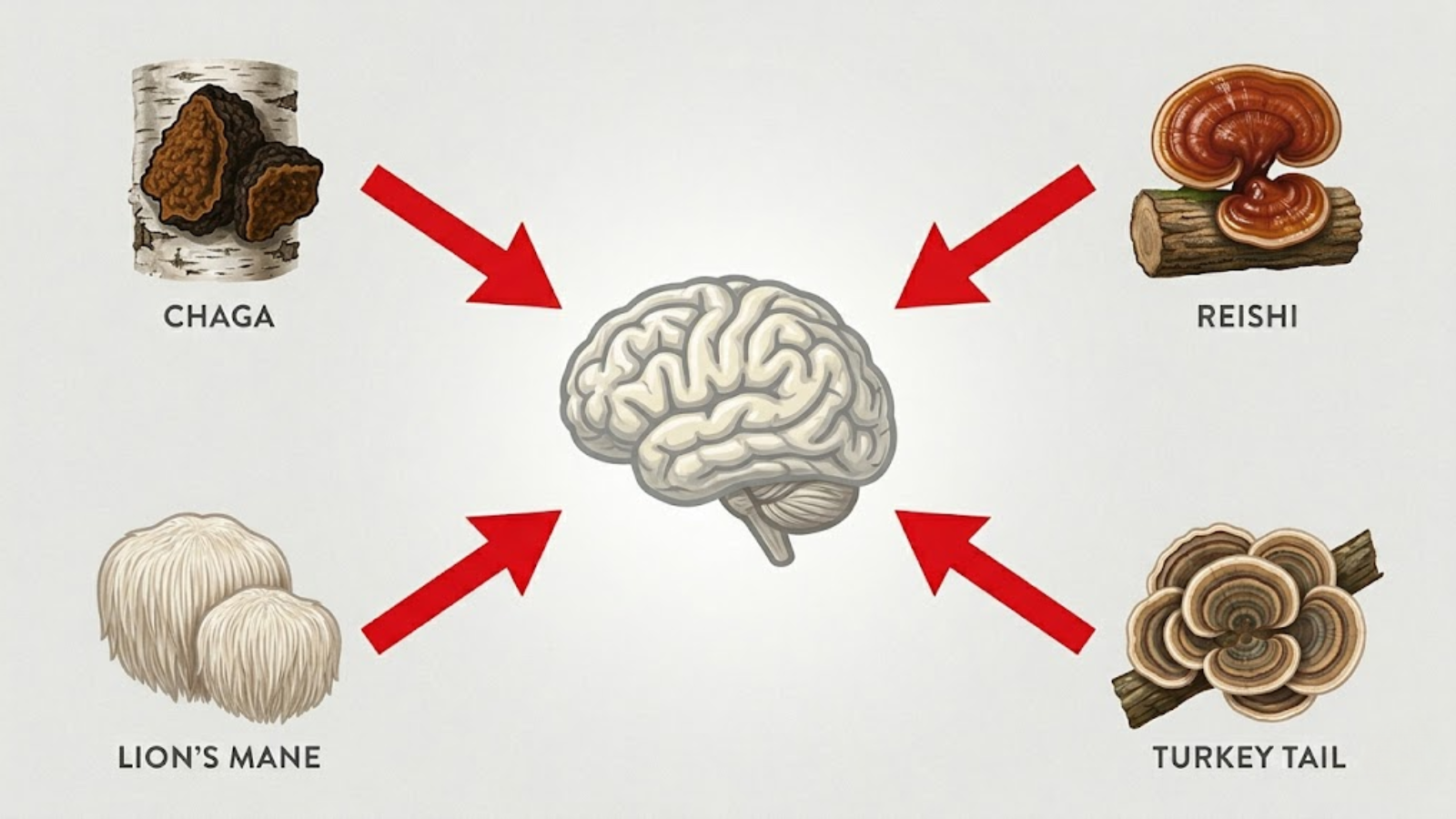
Lion's Mane: the only known natural compound that stimulates NGF production.

Reishi: used for over 2,000 years in traditional medicine, now validated by modern clinical trials.
Turkey Tail and Chaga provide the protective layer that makes the other mechanisms sustainable long-term.
Why I'd Tried Standalone Mushroom Products Before — and Why They Didn't Work
I need to address this because it almost stopped me from ordering.
Two years ago, I bought a standalone Lion's Mane capsule from a well-known brand on Amazon. Took it for 6 weeks. Noticed nothing. Dropped it. Wrote off mushroom supplements entirely.
Here's what I didn't understand then:
Taking Lion's Mane alone is like renovating a house while someone is setting it on fire. You might stimulate NGF production, but if cortisol is still elevated and your mitochondria can't produce enough energy to support those new neural connections, the benefit is marginal at best.
Taking Reishi alone calms the stress response — but doesn't rebuild the neural pathways that chronic cortisol has already damaged.
Taking Cordyceps alone gives your neurons more fuel — but more fuel in a brain that's lost its repair mechanism is like putting premium gas in a car with a cracked engine block.
The protocol only works when all four layers operate simultaneously. Lion's Mane rebuilds. Reishi regulates. Cordyceps refuels. Turkey Tail and Chaga protect. Remove any one layer and the others can't sustain their effects. This is systems biology — not single-ingredient supplementation.
That's why my standalone Lion's Mane didn't work. I was addressing one root cause out of three. Like putting a Band-Aid on one wound while bleeding from two others.
Try the 4-Layer Mushroom Protocol →All 10 mushrooms · 100% fruit body · 60-day guarantee
The Stack Elimination: What I Dropped, Kept, and Replaced
This table changed everything for me. I mapped each of my old supplements against the Sky Nutrition formula and asked a simple question: is this mushroom blend covering the same mechanism at a comparable or better level?
| My Old Supplement | Cost | Replaced By | Status |
|---|---|---|---|
| Lion's Mane capsules | $45/mo | Lion's Mane (fruit body, clinical dose) | DROPPED |
| Ashwagandha (KSM-66) | $28/mo | Reishi (cortisol modulation) | DROPPED |
| CoQ10 (ubiquinol) | $42/mo | Cordyceps (mitochondrial ATP) | DROPPED |
| Alpha-GPC | $32/mo | Lion's Mane + Cordyceps synergy | DROPPED |
| L-theanine | $25/mo | Reishi (calm without sedation) | DROPPED |
| B-complex | $18/mo | Shiitake + Maitake (B vitamins) | DROPPED |
| Omega-3 fish oil | $35/mo | — | KEPT |
| Magnesium L-threonate | $22/mo | — | KEPT |
| Vitamin D3 + K2 | $15/mo | — | KEPT |
Six supplements replaced. Three kept — because omega-3s, magnesium, and vitamin D are foundational nutrients that the mushroom blend isn't trying to cover. I respect a product that doesn't pretend to do everything.
The Math: $347 → $87
From $11.57/day down to $2.90/day. That's a 75% reduction in cost for coverage that's equal or better across every mechanism I was targeting — plus a neuroprotection layer I didn't have before.
Even if you buy the single bag at full price, Sky Nutrition runs $1.46/day. That's still less than what I was spending on Alpha-GPC alone.
With the Buy 2, Get 1 deal, the mushroom portion drops to $0.97/day. Under a dollar. For coverage that replaced $6.33/day worth of individual supplements.
Get the Buy 2, Get 1 FREE Deal →$0.97/day · Free shipping · 60-day guarantee
What Actually Happened When I Made the Switch
I'm a data person. I wasn't going to just "feel" my way through this. I use a Whoop for HRV and sleep, I track my cognitive tasks in Notion, and I keep a daily energy journal. Here's what I recorded over 8 weeks:
Am I saying the mushroom gummies did all of that by themselves? No. I'm saying I replaced six supplements with one product, saved $260 a month, and every metric I track either stayed the same or improved. That's the part that surprised me.
What a Neurologist Says About the Stack-Replacement Approach

"There's strong rationale for a synergistic mushroom approach over isolated compounds. Lion's Mane stimulating NGF, Cordyceps supporting mitochondrial output, and Reishi modulating cortisol — these aren't redundant mechanisms. They're complementary. For patients who are already spending significantly on individual nootropics, a well-formulated multi-mushroom blend can provide equivalent or superior coverage at a fraction of the cost and complexity. The compliance benefit alone — one pleasant gummy versus six pills — meaningfully improves outcomes."
The Product: Sky Nutrition Ultimate Mushroom Daily Gummies
I held off on naming it until now because I wanted you to understand the why before the what. The science has to make sense first. If it doesn't, no amount of branding matters.

Ten mushrooms. All 100% fruit body extract. No mycelium filler. Including every mushroom in the 4-layer protocol — Lion's Mane, Reishi, Cordyceps, Turkey Tail, and Chaga — plus five additional species with complementary mechanisms:
- Lion's Mane — NGF stimulation, cognitive function
- Reishi — cortisol regulation, sleep quality, immune modulation
- Cordyceps — mitochondrial ATP production, oxygen utilization
- Turkey Tail — gut-brain axis support, prebiotic fiber, immune function
- Chaga — highest antioxidant score of any food, neuroprotection
- Maitake — blood sugar stabilization (glucose spikes wreck focus)
- Shiitake — B-vitamin precursors for neurotransmitter production
- Black Fungus — circulatory support, improved blood flow to the brain
- Royal Sun — anti-inflammatory, hepatoprotective
- White Button — ergothioneine, a potent neuroprotective antioxidant
FDA-registered facility. GMP-certified manufacturing. Third-party tested with published COA. Over 50,000 customers and 13,000+ reviews with a 4.8-star average.
And it's a gummy. This sounds trivial, but compliance matters. I actually take it every day because it tastes like wild raspberry, not capsule filler. Three years of swallowing horse pills and now I look forward to it.
Try the 10-Mushroom Blend →Join 50,000+ customers · 60-day money-back guarantee
What If You Keep Spending $200+ a Month on Supplements That Overlap?
I don't say this to pressure you. I say it because I spent three years not asking this question.
If you're running a multi-supplement stack right now, pull out a piece of paper and do what I did. Write down every product. Write down the monthly cost. Then write down what mechanism each one targets.
I'm willing to bet at least three of your supplements are targeting overlapping pathways. That's not your fault — it's how the supplement industry works. Each brand sells you one ingredient and never mentions that their product needs three other compounds to be effective.
The real cost of a scattered stack isn't just money. It's the complexity that kills compliance. It's the 4-minute morning ritual that you skip on weekends. It's the cognitive load of managing nine different reorder cycles. It's the nagging question of whether any of this is actually working because you can never isolate what's doing what.
Simplification isn't compromise. It's optimization. If one product can cover six mechanisms at a higher quality level, keeping six separate bottles isn't discipline — it's inertia.
Other Stack-Replacers Are Saying the Same Thing
I'm not the only one who did the math. From the 13,000+ verified reviews:
I track everything — Oura ring, blood panels every 90 days, continuous glucose monitor. I've been stacking nootropics for about five years. Started Sky Nutrition because I wanted to simplify. Dropped my standalone lion's mane, ashwagandha, and cordyceps. After 6 weeks my HRV is the highest it's been since I started tracking. Sleep latency dropped by 12 minutes on average. I didn't think a gummy could do this. The COA sold me and the data kept me.
I'm almost embarrassed to say how much I was spending. Alpha-GPC, lion's mane tincture (the expensive liquid kind), phosphatidylserine, CoQ10. My husband called it my "brain tax." I gave these gummies 60 days because I know adaptogens need time. By week 5, I felt the same or better than my full stack. Dropped four products. I'm saving over $160/month and my afternoon energy is honestly better than before. I think the synergy between the mushrooms actually matters.
I'm an ER nurse. I needed mushroom support specifically for 12-hour shift brain fog but I refused to buy mycelium-on-grain products — they're basically expensive rice powder. I emailed Sky Nutrition and asked for their COA before ordering. They sent it within a day. Polysaccharide content was legit. Beta-glucan levels were where they should be. My night shift cognition is noticeably sharper after 3 months. I can keep patient details straight at 3am without the jittery feeling from extra caffeine.
50,000+ customers · 4.8 stars · 60-day guarantee
Current Pricing (While the Sale Lasts)
Here's the math. MSRP is $49.99 per bag. The current bundle deals drop the per-bag cost significantly — especially if you want to give it the full 90 days I'd recommend.
For context: I was spending $11.57/day on supplements. Even the single bag is $1.46/day. The Buy 2, Get 1 drops it to $0.97. If you're currently running a multi-supplement stack, pull up your last few Amazon orders and add up what you're spending — then compare.
⚠ The Buy 2, Get 1 FREE deal is limited — once current stock runs out, it goes back to full price.
Get the 90-Day Bundle — $87.49 →Buy 2, Get 1 Free · Free Shipping · 60-Day Guarantee
Try it for a full 60 days. If you don't notice a difference in your clarity, focus, and energy — or if you don't end up dropping at least a few supplements from your current stack — get a complete refund. No questions, no hoops, no fine print. Sky Nutrition covers the risk so you don't have to.
My Final Thought
If You're Spending $200+ a Month on Brain Supplements, Do the Exercise
I'm not saying throw away your entire stack tomorrow. I'm saying do what I did: pull out the ingredient panel for each product you take, write down the mechanism it targets, and see how many of those bottles are doing something a well-formulated mushroom blend already covers.
The things to check: fruit body vs. mycelium (non-negotiable). Clinical dosing (not pixie-dusted). Third-party COA (ask for it — if they can't produce one, walk away).
Sky Nutrition checks all three. It replaced six of my nine daily supplements, saved me $260 a month, and every metric I track held steady or improved over eight weeks.
That's not a miracle. That's just better math.
— Rachel K., 46, Austin, TX
Join 50,000+ customers protecting their brain health daily
Rachel, THANK YOU for this. I just added up my supplement stack and I'm at $289/month. I didn't even realize. Lion's mane, ashwagandha, CoQ10, fish oil, and like 4 others. I've been running on autopilot with auto-ship subscriptions and never questioned it. Ordering the 90-day bundle right now. If it covers even half of what you described I'm coming out way ahead.
Sarah — do the mapping exercise I described. Write down each supplement and the mechanism it targets. I bet you'll find at least 3-4 that overlap with what the mushroom blend covers. And cancel those auto-ships! That's how they get us. Good luck, report back.
I've been taking these for 10 weeks now. I'm 64. Retired CPA. My wife bought them for me because I kept forgetting where I put things. Around week 4 something shifted. I can't explain it other than the "fog" lifted. I started doing the NYT crossword again — hadn't touched one in two years because I couldn't finish them. Last Sunday I finished it. In pen. My wife cried. So did I, honestly.
The part about standalone Lion's Mane not working hit me hard. I tried a lion's mane capsule from Amazon for 2 months and thought mushroom supplements were all hype. Reading the explanation about needing all four layers working together made me realize I wasn't giving it a fair test at all. Just ordered the 90-day bundle. Fingers crossed.
Reporting back — 8 weeks in. I'm a high school principal, 56. Perimenopause brain fog was the worst part. I could handle the hot flashes. I couldn't handle forgetting a teacher's name who's worked for me for 12 years. EIGHT WEEKS IN: the fog is about 80% gone. Not perfect, still have off days. But the consistent, every-single-day fog that made me question my competence? Gone. I dropped my ashwagandha and L-theanine like Rachel described. Just ordered the 5-bottle bundle.
Did the math Rachel suggested. I was spending $214/month on brain supplements. FOURTEEN supplements total (some overlap because I'm taking things "just in case"). The stack mapping exercise was eye-opening. I'm dropping 8 of them and keeping 6 — the mushroom gummies plus my foundational stuff. That brings me from $214 to about $95. Saving $119/month. Not as dramatic as Rachel's $260 but I'll take it.
Nobody's mentioning the sleep improvement. I've had insomnia for 6 years — the "wake up at 3 AM and stare at the ceiling" kind. I started these for the brain fog but the sleep improvement hit first, around day 10. I'm sleeping through the night for the first time since 2020. The brain fog improvement came later, around week 5. But the sleep alone would have been worth the price.
I'm only 44 but I work in tech and my job requires holding 15 things in my head at once. Lately I can barely hold 5. I was spending about $180/month on nootropics — Alpha Brain, lion's mane, fish oil, the works. Rachel's article made me realize how much overlap there was. Ordered the bundle. Will report back in 8 weeks with data.